
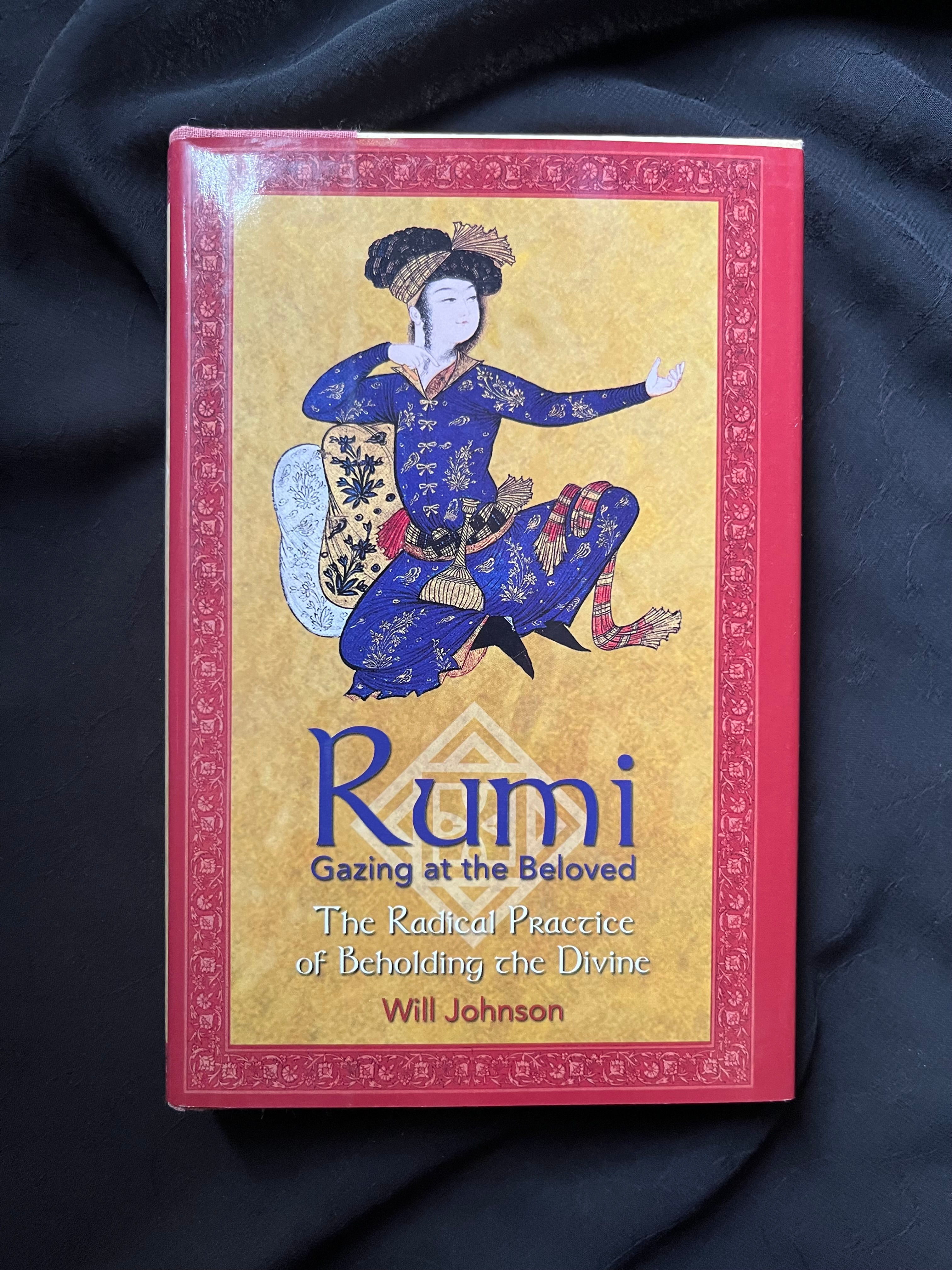

By Jalal ad-Din Muhammad ar-Rumi, Will Johnson (Translator) (New, Poetry, Esoteric, Sufism, Mystical, Spirituality)
Published by Inner Traditions, 2003 Condition - As New Hardcover, 224 pages
Genre - Poetry, Nonfiction, Esoteric, Sufism, New, Mystical, Spirituality
★★★★☆
Rumi: Gazing at the Beloved - The Radical Practice of Beholding the Divine
Reveals the esoteric techniques of achieving divine Union based on the practices of the Sufi poet Rumi and his mysterious spiritual companion Shams-i-Tabriz.- Reveals the actual practices that transformed Rumi from a conventional Islamic scholar into the mystical poet who originated the dance of the whirling dervish. - Demonstrates how anyone can achieve similar states of ecstatic divine Union through the simple practice of intentional gazing. - Interweaves the poetry and writings of Rumi to document this radical practice. One of the most extraordinary events in the history of Sufism occurred in 1244, when the Sufi poet, mystic, and originator of the dance of the whirling dervish, Jallaludin Rumi, met a wandering seeker named Shams-i-Tabriz. Upon meeting, the two men immediately went into private retreat together and emerged 90 days later in a transformed condition. While the relationship between Rumi and Shams is highly revered within the Sufi tradition, the exact nature of what transpired between them has remained a mystery for the past 750 years. "Rumi: Gazing at the Beloved" reveals for the first time the actual esoteric practice that Rumi and Shams were engaged in behind the closed doors of their retreat room. Using the poetry and words of Rumi to document this radical practice step-by-step, Will Johnson resolves this long-standing spiritual mystery by conducting an extensive search through Rumi's life to uncover the mystical secrets of divine Union in sacred friendship and intimate partnering. In doing so, he presents a practice that anyone can engage in to attain the same ecstatic state of divine Union experienced by Rumi and Shams so many centuries ago.
Sufism inspired writings of Persian poet and mystic Jalal ad-Din Muhammad ar-Rumi; these writings express the longing of the soul for union with the divine. Jalāl ad-Dīn Muhammad Rūmī - also known as Jalāl ad-Dīn Muhammad Balkhī, Mevlânâ/Mawlānā (مولانا, "our master"), Mevlevî/Mawlawī (مولوی, "my master") and more popularly simply as Rumi - was a 13th-century Persian poet, jurist, Islamic scholar, theologian and Sufi mystic who lived in Konya, a city of Ottoman Empire (Today's Turkey). His poems have been widely translated into many of the world's languages, and he has been described as the most popular poet and the best-selling poet in the United States. His poetry has influenced Persian literature, but also Turkish, Ottoman Turkish, Azerbaijani, Punjabi, Hindi, and Urdu, as well as the literature of some other Turkic, Iranian, and Indo-Aryan languages including Chagatai, Pashto, and Bengali. Due to quarrels between different dynasties in Khorāṣān, opposition to the Khwarizmid Shahs who were considered devious by his father, Bahā ud-Dīn Wālad or fear of the impending Mongol cataclysm, his father decided to migrate westwards, eventually settling in the Anatolian city Konya, where he lived most of his life, composed one of the crowning glories of Persian literature, and profoundly affected the culture of the area. When his father died, Rumi, aged 25, inherited his position as the head of an Islamic school. One of Baha' ud-Din's students, Sayyed Burhan ud-Din Muhaqqiq Termazi, continued to train Rumi in the Shariah as well as the Tariqa, especially that of Rumi's father. For nine years, Rumi practised Sufism as a disciple of Burhan ud-Din until the latter died in 1240 or 1241. Rumi's public life then began: he became an Islamic Jurist, issuing fatwas and giving sermons in the mosques of Konya. He also served as a Molvi (Islamic teacher) and taught his adherents in the madrassa. During this period, Rumi also travelled to Damascus and is said to have spent four years there. It was his meeting with the dervish Shams-e Tabrizi on 15 November 1244 that completely changed his life. From an accomplished teacher and jurist, Rumi was transformed into an ascetic. On the night of 5 December 1248, as Rumi and Shams were talking, Shams was called to the back door. He went out, never to be seen again. Rumi's love for, and his bereavement at the death of, Shams found their expression in an outpouring of lyric poems, Divan-e Shams-e Tabrizi. He himself went out searching for Shams and journeyed again to Damascus. Rumi found another companion in Salaḥ ud-Din-e Zarkub, a goldsmith. After Salah ud-Din's death, Rumi's scribe and favourite student, Hussam-e Chalabi, assumed the role of Rumi's companion. Hussam implored Rumi to write more. Rumi spent the next 12 years of his life in Anatolia dictating the six volumes of this masterwork, the Masnavi, to Hussam. In December 1273, Rumi fell ill and died on the 17th of December in Konya.
Will Johnson received his B.A., magna cum laude, in Art and Archaeology from Princeton University in 1968. After graduation, he worked for several years as an art critic in New York before moving to the west coast of North America where he began actively exploring gazing, moving, and sitting meditations. He became a Buddhist practitioner in 1972 and was trained as a Rolfer™ in 1976. He began the formal sharing of the practices of Embodiment Training in 1995.